Pre-Cardboard treasures
Like many others, I enjoy sports card collecting as an interactive way of learning the history of a sport. But what should one do, when you discover legendary players that were around before cigarette cards existed? Luckily for association football collectors, there are “shield cards” that were made by Briggs, Baines, and Sharpe as well as various other producers, which go back to the late 1870s. However, these beautiful cards are extremely hard to find from this era, and often featured teams instead of the players themselves. Cabinet cards or CDVs from the era are equally wonderful collectibles, but equally difficult to find of famous footballers.
An interesting alternative is to collect chromolithograph, lithographs, etchings and prints of legendary footballers in various publications from the period. Periodicals such as Boy’s Own Paper and The Illustrated Sporting News Dramatic, the Graphic, the Sketch and others made some absolutely stunning lithographs of footballers, giving collectors a unique chance to own genuine period portraits of pre-cardboard football greats. These are also becoming increasingly scarce but perhaps more obtainable than CDVs or early shield cards.
This section will outline some of the most notable prints from the era, highlighting a few of the footballing legends featured in these exceptional works of art.
1. The Boys Own Paper – Famous Footballers – 1881
The first, and probably the most iconic chromolithograph ever produced is the Boys Own panel portrait entitled Famous English Football Players from 1881. This beautifully rendered fold-out picture captures some of the preeminent players of the era with breathtakingly vivid colours. It is a true masterpiece.
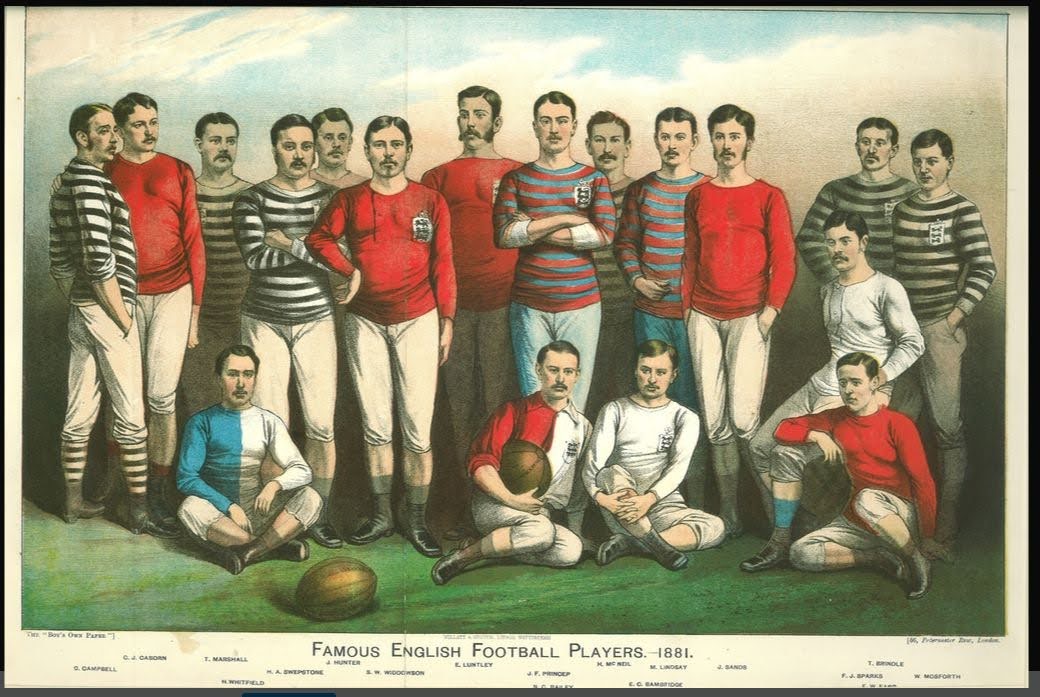
Player highlights

Charles Campbell – Queens Park
Campbell played for and captained both Queens Park and Scotland’s international team (8x), and was arguably the best player of the late 1870s and early 1880s. Queens Park emerged as a dominant force in British football winning the Scottish Cup an incredible eight times and made two FA cup final appearances. Leading the team, the speedy Campbell was great in the air and a sensational playmaker.
At the international level, Campbell only lost once against England out of ten matches played. He is generally considered to be the best mid-fielder in Britain throughout his playing career.

Charles Bambridge – Swifts
Charlie Bambridge was gifted winger, who played his best days for Swifts F.C. At that time, Swifts were a strong club and produced several England players, but Bambridge is by far the most notable among them. Bambridge was selected to represent England an incredible 18 times including as captain twice. During his 18 international games, he scored an impressive 11 times and was the England scoring leader in 1879, 1881 and 1885.
Legends follow legendary players, and it is said that Bambridge scored the winning goal in a cup tie game with a broken leg.

Henry McNeil – Queens Park
Like George Campbell, Harry McNeil played for the dominant Queens Park and was an important Scottish International.
Harry’s brothers Moses and Peter were founding members of the Rangers Football Club in Glasgow. However, Harry who got his start with Third Lanark, surpassed his brothers as a player going on to be one of the best Scottish players of the era.
McNeil was speedy and crafty, playing multiple positions as a winger, inside-forward and half-back and became an integral part of the famous Queen’s Park team that helped revolutionize the game in the 1870 and 80s. He would go on to win five Scottish Cups during his career.
Norman Bailey – Clapton Rovers
Bailey was a fast and strong half back, who played with the Old Westminsters, Clapton Rovers, Swifts, Wanderers and Corinthians. He was a consistent, clever player and a regular selection for the English National team with 19 appearances, including as captain for the English side three times. With Clapton, he reached the FA Cup finals three times and won the Cup once.
He is generally considered one of the greatest amateur center half backs to play the game.
2 – The Illustrated Sporting News Dramatic – Football at the Oval – Middlesex V. Oxford – 1884
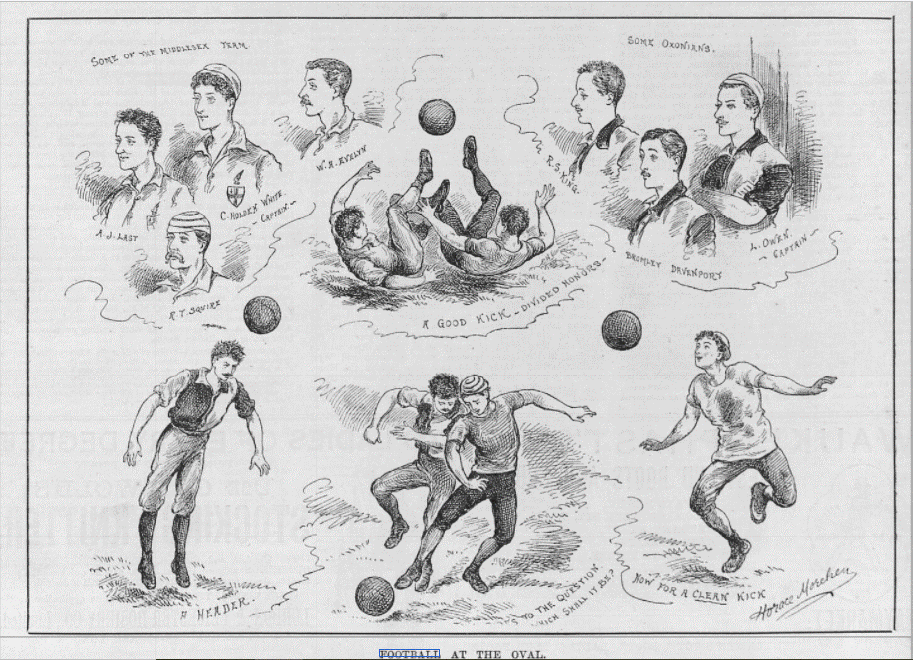
Notable players:

William Bromley Davenport – Oxford
Davenport played for Oxford, Old Etonions, and Corinthians as well being an English International on two occasions throughout his career. However, Davenport is best known for his distinguished military and political career.

Cecil Holden White – Middlesex
White played for Clapton Rovers, Swifts and represented England twice. He also joined Corinthians in 1892, where became the club’s first captain.
3. The Illustrated Sporting News Dramatic – Cambridge Vs. Oxford -1886
A wonderful uncoloured lithograph from The Illustrated Sporting News Dramatic featuring the historic rivalry of Cambridge versus Oxford Universities.

This lithograph is particularly special as it contains two of greatest players of their generation: Nevill Cobbald and Tinsley Lindley.
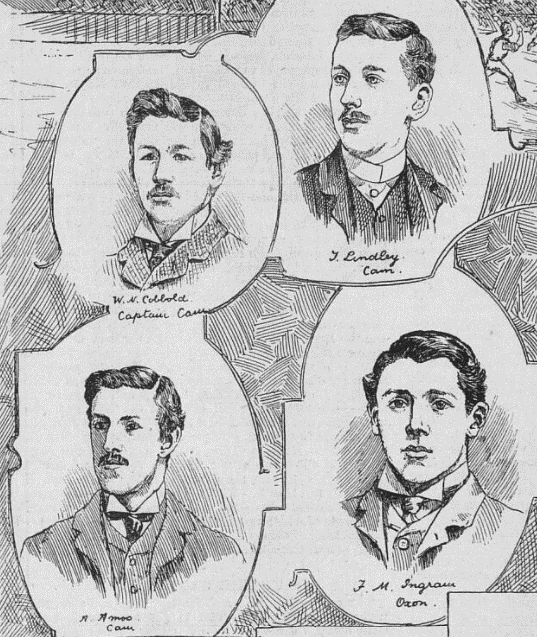
W.N. Cobbold – Cambridge
William Neville Cobbold or “Nuts” as he was known, was the most outstanding forwards of the 1880s known for his speed and magnificent dribbling ability. William Pickford commented in 1906 that “if one were to ask, who were the three greatest forwards of all time? No matter what other two were named, W.N. Cobbold would perhaps come first to the lips.” G.O. Smith ranked him above as the best strikers he had known, above notable players such as “Bloomer” and “Meredith” with . The speedy forward earned 9 caps for his country.
Tinsley Lindley – Cambridge
This lithographic is particularly exciting as it offers a rare picture of Lindley in his time at Cambridge. Lindley would go on to become a legendary player for Notts Forest. He was described as the “ideal center” and was revered in the association football world after his playing career was finished.
Andrew Amos – Cambridge
Amos was a strong player from the era who earned two caps for his country. He also went on to play for the historic amateur clubs the Old Carthusians and Corinthians
Francis M. Ingram – Oxford
Ingram went on to play for the Old Westminsters and Corinthians at a time when they were one of the dominant teams in the football world.
4. The Illustrated Sporting News Dramatic – Old Carthusians V. Preston North End -1887
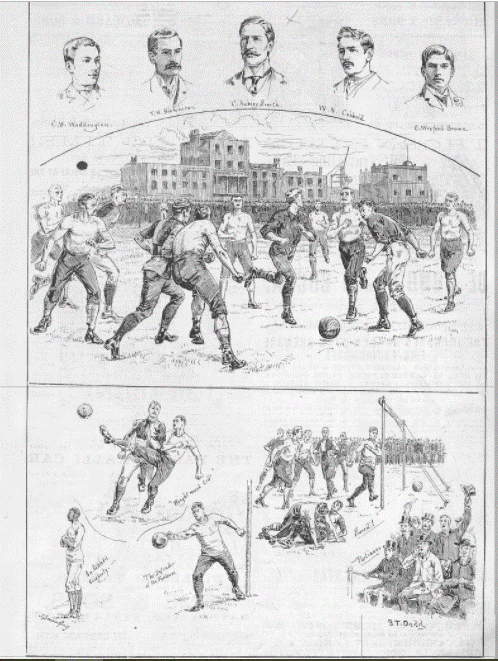
C.W. Waddington T.W. Blenkiron C. Aubrey Smith W.N. Cobbold C. Wreford Brown
Notable Players
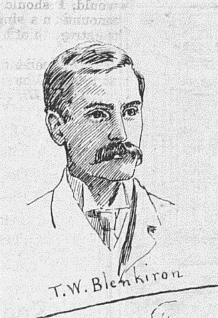
Thomas W. Blenkiron – Old Carthusian
Blenkiron was a Cambridge University Football blue and Old Carthusian. He is also credited with picking the unusual chocolate and pink uniforms when the Casuals football club was formed.

Charles Aubrey Smith – Old Carthusians
Smith became a well known cricketer, but achieved his greatest fame through his distinguished acting and film career.
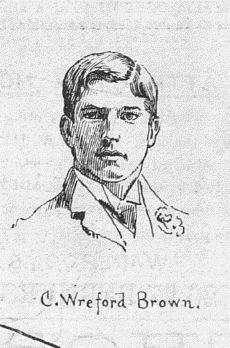
Charles Wreford Brown – Old Carthusians
Brown is one of the early footballs most venerable and influential personalities. He played and captained the Old Carthusians, Corinthians and England on multiple occasions. He is also credited with inventing the term soccer. This lithograph gives us a rare chance to see Wreford Brown without his customary thick moustache.
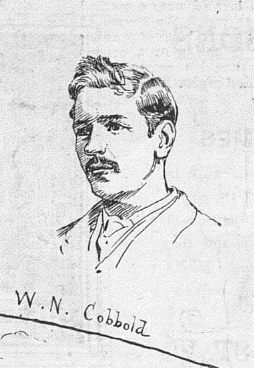
William Nevill Cobbold – Old Carthusians
The great Cobbold is once again featured in this lithograph. See biography above.
5. The Illustrated Sporting News Dramatic – F.A. Cup Winners Aston Villa – 1887
A beautiful team portrait print featuring the venerable striker Archie Hunter.

Notable player:
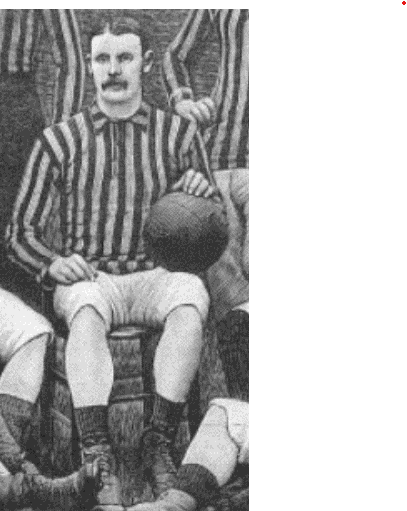
Archie Hunter captained the first Aston Villa squad to win the FA cup in 1887. He was their star player noted for his exceptional dribbling. He played the last two years of his stellar career in the newly formed football league. Consequently, he was the second player selected to Football League’s 100 Legends after West Bromwich’s Billy Bassett.
6. The Boys Own Paper – Our Leading Footballers – 1888
This beautiful full-page lithograph was completed with sepia etchings of prominent footballers of the day. The portraits are numbered; however, the print is frequently (but not always) found with the bottom cut off of the final line of players.

Complete players list
1. P.M. Walters 2. D. Drummon 3. S. Thomson 4. J.H. Dewhurst 5. R. Robertshaw
6. G.L. Jeffrey 7. W.N. Cobbold 8. T.W. Blenkiron 9. H. Stringmann 10. E. Wilkinson
11. A.E. Stoddart 12. A.M. Walters 13. L. Owen 14. F. Dewhurstn 15. J. Forbes
16. G. Howarth 17. P. Don-Wauchope 18. J. Goodall 19. W.F. Holms 20. H.B. Tristram
Notable players
William Neville Cobbold – Corinthians
Cobbold is once again featured in this lithograph cementing his status as one of the top players of the 1880s. Biography above.
John Goodall – Preston North End
While Goodall managed to ge a football card playing for Derby County issued by Ogden’s Cigarettes in 1900, this lithograph portrays Goodall at Preston North End when his team were called the “Invincibles”. Goodall would go on to be the best player of the 1890s.

 The Cardboard Junkie