The Victorian George Best

One of the most talented football wingers of all time, Fred Spiksley (pronounced Spike slee) has been dubbed “the Victorian George Best“. Both players were star wingers known for their dazzling dribbling and scoring skills and phenomenal showmanship. But perhaps the parallels between the two are even more dramatic for their behavior off the pitch. Both lived a life in the fast lane that included gambling, women, parties and the odd tussle. George Best’s life both on and off the pitch has been well documented and discussed, but who exactly was Fred Spiksley? This article is going to provide an overview of the exceptional player who lived an extraordinary life.
The Player
Fred Spiksley was born in 1870 and grew up in Gainsborough England. He was a prodigious footballing talent, playing for a junior club called the Jubilee Swifts. He is reported to have averaged 6 goals a match and even scored 11 in one game.
“Thus early was his marvelous ability for goal getting shown, amounting almost to born genius” The Sheffield Daily Telegraph December 28, 1896
He then moved onto Gainsborough Trinity, where played 126 games and scored 131 goals. His remarkable speed, skill and scoring ability captured the notice of Sheffield Wednesday with whom he signed in 1891. The Wednesday were in the Second division were unanimously elected to the First division the following year. Spiksley was in top form and led the team in scoring with 18 goals in 30 appearances and would go on to lead the team in scoring 5 of the next 6 seasons.
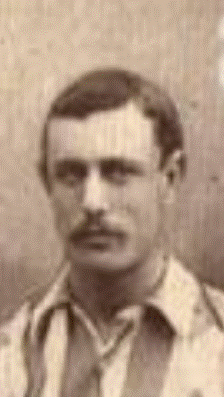
His exceptional play for Sheffield Wednesday earned him his first international cap in 1893 against Wales, where he is reported to have scored 3 goals (officially 2 goals). Consequently, his strong play was rewarded with second cap against Scotland the following month. In this match, he scored the first ever English hat trick against Scotland (although official records list as 2 goals). Spiksley continued his great play and in 1896, he led Sheffield Wednesday to an FA Cup victory. Living up to his renown for being a “big game player”, he scored two goals in the final.
Although Spiksley had a small frame, what he lacked in stature he made up for in speed and was considered “the fastest man in football”. He also had developed incredible dribbling skills with the outside of feet that terrorized defenders. In fact, Spiksley has the highest goals-to-game ratio of any winger in English football history. He was so unstoppable that he earned the nickname “the Wind” after Sheffield United legend Ernest Needham commented on trying to defend him: “I might as well have tried to stop the wind. The outside-left was Fred Spiksley, the finest outside-left I have ever met and whose dribbling was a treat to watch.”
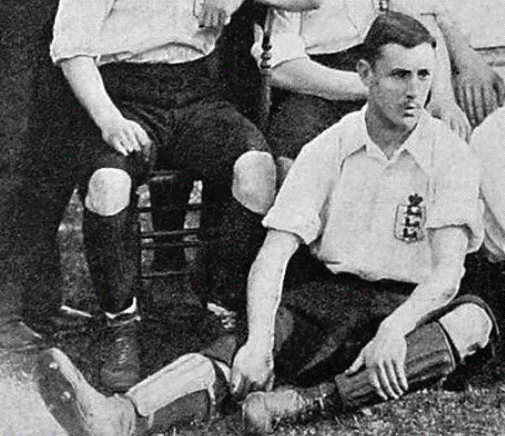
During a Cup Tie game against Burnley in 1893, Spiksley sustained an exceptionally hard foul and was forced to leave the game. However, Sheffield back Tom Brandon convinced Fred to go back on to score one goal, which he did. Later, it was revealed that Spiksley had done so with two broken ribs. The Burnley News Saturday December 28, 1929.
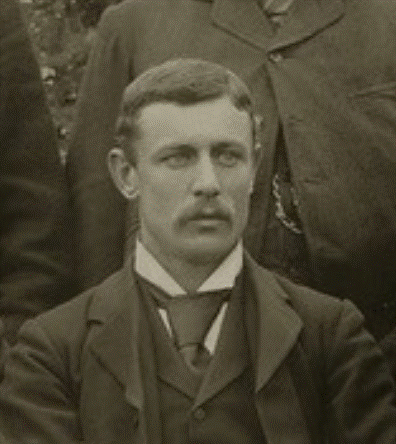
His career declined after suffering severe injuries, particularly in 1903, where he badly injured his knee. He had stints with Leeds City, Watford and Southern United, but was unable to regain his previous form and decided to retire in 1906.
Off the pitch, Spiksley was as entertaining as he as a footballer. He liked to liven crowds playing piano in the pub and enjoyed life as ladies man despite his married status. In fact, he ended up divorcing his wife due to his adulterous behavior. He was also a notorious gambler spending most of his earnings at the race track. Like Best, he led the reckless lifestyle of a flawed football hero and throughout his life, Spiksley faced financial hardships due to his compulsive gambling addiction.
One might expect that being a star football player might be the most exceptional stage of his life. However, his life after retirement from football were equally remarkable filled with extraordinary events.
The Actor
Once his football career was over, the colourful Spiksley took his good looks to the stage. In 1906, after responding to an advertisement, he joined a production by the great English theatre impresario Fred Karno who cast him in a play entitled The Football Match’ for more than 50 performances. Two of the other actors in the sketch were named Stan Jefferson and Chas Chaplin, who would become two of the most famous comedians of the era as Stan Laurel (Laurel and Hardy) and Charlie Chaplin. During this period, Spiksley also became a football referee for a short while in 1908, but this career wasn’t well suited for the hot-headed Spiksley. Sheffield Daily Telegraph – Friday 18 September 1908
The Football Coach
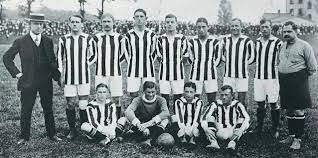
As Spiksley wasn’t destined to go to Hollywood with Laurel and Chaplin and decided to return as a football coach in 1910. He had developed sophisticated training techniques, such as emphasis on pass-and-move, that were considered too unorthodox for English football. As a result, he decided to take his coaching knowledge abroad to multiple foreign countries including the United States, Mexico, Peru, France, Sweden, Switzerland and Germany. In 1911, Spiksley found success when managed the Swedish national team as well as AIK Stockholm to a league title. He is credited with transforming Swedish football and was far ahead of his time with innovative drills that can still be witnessed by top tier teams today. In 1913, he moved to Germany and managed the Nürnberg team to victory in the German championship.
The Pow
While at Nürnberg in 1914, the First World War broke out and he was imprisoned by the German authorities for three months. He was able to escape detention by demonstrating that he was unable to fight due to the knee injury he had suffered in 1903 football seasons. In fact, he purposefully dislocated his knee during an examination by a German physician. He then managed to escape with his German wife to neutral Switzerland before returning home to England.
The Innovator
In 1924, Spiksley signed a a two-year contract to coach Fulham and then back to Germany to coach again at Nürnberg. Ever the innovator, Spiksley created what is believed to be the first educational films on football technique for coaches. Spiksley had strong opinions about how football should be taught and in 1933 secured a position at King Edward VII School in Sheffield. In fact, Spiksley had plans to open his own school where football was an integral component yet it never came to fruition.
A Remarkable End to A Remarkable Life
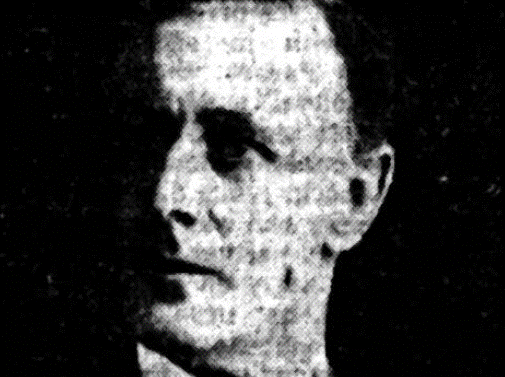
Fred Spiksley’s death was almost as astonishing as his life. The great footballer who had travelled the globe, lived life in the fast lane with mistresses on multiple continents, and bet his earnings on horse racing finally succumbed to heart attack in 1948 at age of 78. Like the rest of his life that was something out of a movie script, he was found at the race track clasping a winning ticket in his hand. Of course, it was Ladies Day.
Cigarette Card Chronology
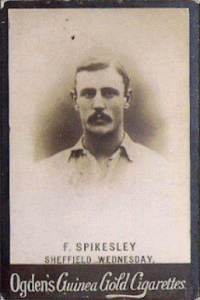
Rookie card: Year 1896 – Manufacturer Ogden’s Cigarettes – Set – Guinea Gold Footballers Base M(d) Set 385s – Card # – Unnumbered – Blank Back
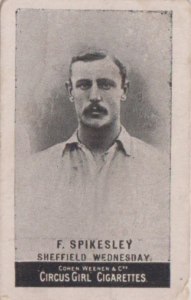
Year 1897 – Manufacturer Cohen Weenen & Co. – Set – Heroes of Sport – Circus Girl Cigarettes – Unnumbered – Blank Back
Year 1901 – Manufacturer – F & J Smith Cup Tie Cigarettes – Set – Footballers – Card #48

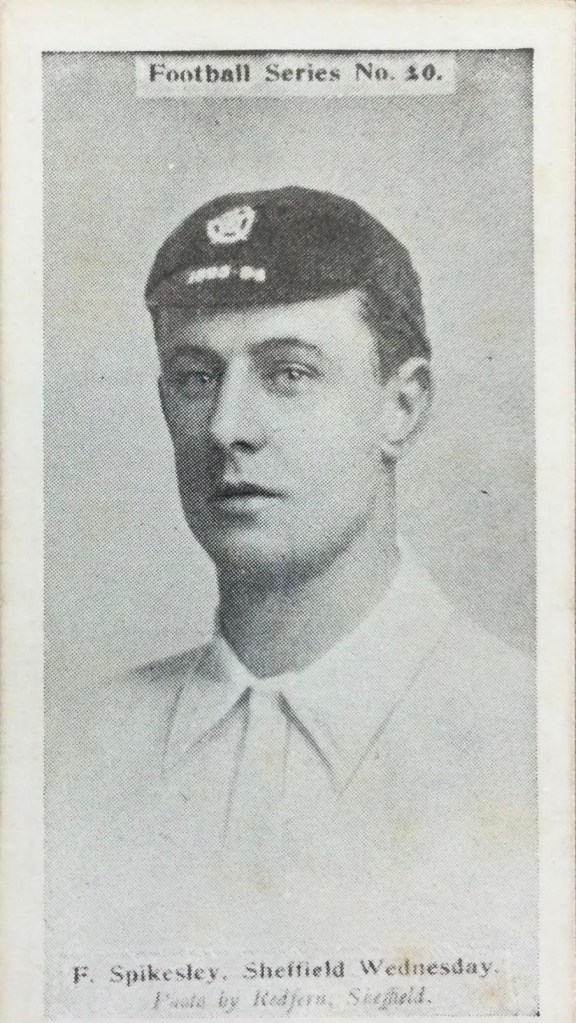
Year 1902 – Manufacturer -W. M. Clarke & Sons – Set – Football Series – Card # – 20
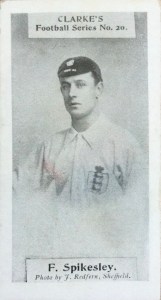
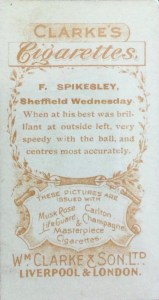
Year 1902 – Manufacturer – W.M. Clarke & Son – Set – Football Series – Card # 20
Epilogue
The Remarkable Life of Fred Spiksley details the footballer’s life and achievements and a movie based on his life is expected to be released in 2023.

 The Cardboard Junkie
2 thoughts on “LOAFRs 17 – Fred Spiksley”