John Campbell 1, Ned Doig, Andy Aitken, John Cambell 2, JAMES COWAN,
While reading about the history of football at the turn of the 19th century, I was struck by a thought. Almost all of the most famous players associated with this era were from England such as the likes of Bassett, Goodall, Athersmith, Crabtree, Spiksley, G.O. Smith and Steve Bloomer. And yet, when I read about the international games, it seemed as though Scotland was generally the better team, certainly a better record. The more I read, I increasingly realized that during the period prior to the 1900s Scotland was every bit as good if not better than England. Yet, the names of Scotland’s football hero’s aren’t as widely known or as popular as the English players primarily because they didn’t receive the same press coverage in England. So like in the movie Braveheart, when Argyle Wallace discovers that young William was ignorant of Latin, he states “that’s something we shall have to remedy, isn’t it”.
So this section is the first installment dedicated to some of the greatest unsung Scottish players of the Victorian and early Edwardian eras.

Johnny Campbell No. 1
The first of two Johnny Campbells on the list is best known for his time as the scoring powerhouse at Sunderland, where he became the game’s first truly prolific goal scorer. In the first half of 1890s, he was the heart of a dominant Sunderland offense and led the league in goals for an unprecedented three seasons. Only Bloomer, Greaves and Thierry Henry have led the English league more times in their career than Campbell. In the 1891-92 season, Campbell set the single season goal record scoring an incredible 32 goals in only 26 games (1.23 goals per game), which beat his previous year’s total of 31. To put this accomplishment context, the scoring record stood for 18 years until Bert Freeman scored 38 in 1909. However, that really doesn’t tell the whole story as Freeman scored 38 in 37 appearances. Had Campbell played an additional 12 games and continued at the pace of the previous two seasons, he would have scored almost 48 goals. Derby legend Steve Bloomer highest league scoring season was only 23 goals in 34 games. In fact, Campbell finished his career with a staggering 0.69 goals per game ratio behind only Dave Halliday and Dixie Dean, despite his production falling off dramatically during his time at Newcastle. It’s also worth noting that the off-side rule change which benefited so many later players such as Dean and Camsell. While Campbell may not have enjoyed the career longevity of players like Steve Bloomer or Charlie Buchan, in his prime years, he was a better pure goal scorer than either of them.
Not only was Campbell scoring, but his team was winning. The first year Campbell led the league in scoring in 1891-92, Sunderland were league champions. Campbell and Sunderland repeated the same feats the next year, were runners ups the following year and then won both the league and the scoring title the following year. Unfortunately, Campbell never received a cap for Scotland as he was blacklisted for playing in the English professional league.
Card Notes:
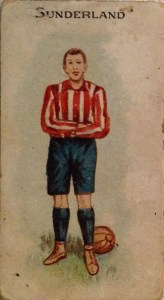
The card does not explicitly state Campbell’s name but rather the team Sunderland. However, it is clear from the artist’s depiction that it is Campbell as only he and Jimmy Hannah did not have moustaches on the team. A very difficult card to find as only a handful are known to exist from this beautiful set.

Card Notes:
Also from 1896/97, Johnny Campbell has a beautiful Guinea Gold card from the all capital letters series. Campbell left for Newcastle in the beginning of the 1897 football season.
Ned Doig
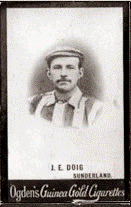
Doig is widely regarded as the best goalkeeper of his era. Although there were other great keepers such as Trainer, Moon and Raikes, none could claim to have the accolades as Ned Doig. He spent his best years with the dominant team of all talents Sunderland squad in the 1890s. Dubbed the “Prince of Goalkeepers”, Doig always wore a cap as it was said that he was shy about having a bald head. One of the best players of his generation, Doig should certainly included among the pantheon of greats from the 1890s.
Rookie Card: Year – 1896/97 – Manufacturer – Ogden’s Cigarettes – Set – Guinea Gold Footballers – 385s Base M – Card # – Unnumbered
Andrew Aitken
During the mid 1900s, Newcastle emerged as a football powerhouse with the likes of star players Colin Veitch, Bill McCracken and, of course, Andy Aitken. Aitken was an exceptional defensive force, not so much because he was quick physically, but rather mentally adept at anticipating plays. His sensational play earned Aitken earned 14 caps for Scotland and he was an integral part of the Newcastle team that found so much success in the early 1900s. Aitken had a lengthy career of almost 20 years in both English and Scottish leagues most notably at Newcastle, Middlesbrough and Dundee.
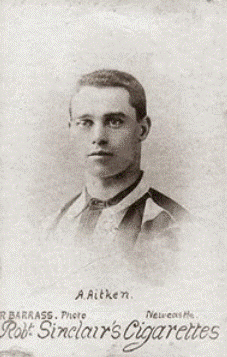
Rookie Card: Year – 1899 – Manufacturer – Robert Sinclair .- Set – Newcastle Footballers – Card # – Unnumbered
Card Notes:
An exceptionally scarce card (perhaps only a couple exist) making this first card of the greatest players of the 1900s a truly special card.
Johnny Campbell No. 2
The second Johnny Campbell was also a dominant forward, who joined Celtic in 1890 and formed one one of the deadliest frontline partnerships with Sandy McMahon. At Celtic, Campbell scored an impressive 43 goals in 74 games and caught the attention of Aston Villa. Consequently, Campbell was lured south to play professionally for Aston Villa from 1895 – 1897. His first year with Villa he led the league in goals with 22 and scored the winning goal in the FA Cup of 1897 to give Aston Villa that gave the famous double, the second team to achieve the feat after Preston North End in 1889. Campbell returned to Scotland, where he continued his winning ways with Celtic by securing the league title in 1897/98 as well as the Scottish Cup in 1899 and 1900 and a league title with Third Lanark in 1903. Campbell was also capped for Scotland 12 times
Rookie Card: Year – 1899 – Manufacturer – Rutherford Cigarettes – Set – Footballers – Card # – Unnumbered

Card Notes:
Another impossible card from almost mythical Rutherford’s Cigarettes set depicts Campbell wearing a suit. Although it is Campbell’s first card, it was issued almost ten years after he first joined Celtic in 1890.
James Cowan
While its fair to say that Aston Villa team of the 1890s was stacked with the likes of Jack Devey, Charlie Athersmith and Jimmy Crabtree, it was Cowan at center half, who was the heart of this incredible Aston Villa machine. Cowan is regarded by historians as one of the highest caliber players of the Victorian era.
Rookie Card: Year – 1900 – Manufacturer – Cohen, Weenen & Co. – Set – Celebrities, Cricketers, Footballers & Jockeys – Card # – Unnumbered


 The Cardboard Junkie
One thought on “LOAFR 21 – The Scottish Edition 1”