The Amazing Scot who outshone G.O. Smith as Football’s Greatest Center Forward
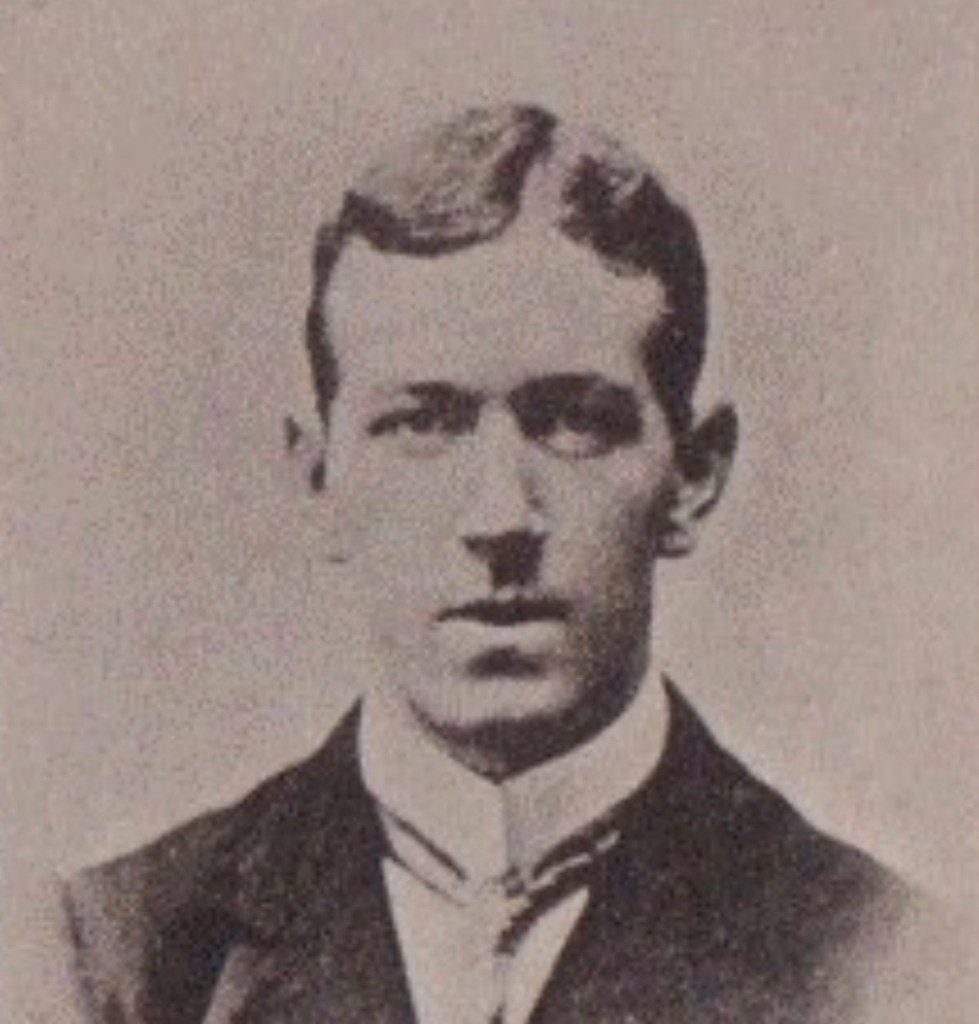
Football’s Greatest Center Forward
The name that invariably emerges during discussions on the greatest association footballer at the turn of the century is usually G.O. Smith. Smith was the darling of English press in the 1890s and early 1900s, known for his outstanding play that was punctuated by his exceptional dribbling, passing and scoring. In short, Smith was the consummate amateur and the very best the game had to offer. But what if he wasn’t? What if there was another center forward equally good or even better, but didn’t garner the same lasting praise from the English press because he was … well, Scottish?

First, let’s talk about G.O. As an amateur, the English adored G.O. Smith’s quick thinking passing play as well as his ability to score netting 113 goals in 131 games with the Corinthians, which was considered by many as the finest football club in the land. But most of all, the English press loved him for his strong international appearances, where he was capped 20 times and scored 11 goals as well as captaining the team on 13 occasions between 1893 and 1901. Smith was the center piece of a very strong English National team consistently included top-quality players such as Billy Bassett, John Goodall, Jimmy Crabtree, Charlie Athersmith, Fred Spikesley and Steve Bloomer. The English national teams of this era typically steamrolled over neighboring countries, such as Wales and Ireland. Yet, one team consistently outplayed this team of superstars: England’s northern neighbor Scotland.
The Scottish national team of late 1890s and early 1900s had an equally exceptional, but lesser known cohort of stellar players, such as Andy Aiken, Alex Raisbeck, Jack Robertson, Alex Smith, James Cowan, Robert Hamilton and Bobby Walker. However, the undisputed star of the team was the sensational center forward called Robert Smyth McColl.
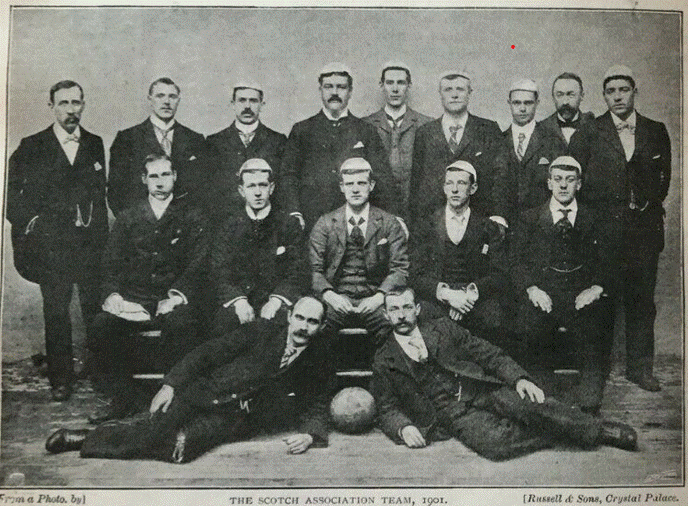

R.S. McColl broke onto the football scene after he joined the famous Scottish amateur club Queens Park in 1894. G.O. Smith’s entry into the top-tier was slightly earlier earning his first international cap in 1893. The international rivalry between England and Scotland from 1893 to 1902 was intense and surprisingly evenly matched with three wins for Scotland, three wins for England and three draws.
By 1896, the brilliance of McColl was already being hailed in the Scottish press as Scotland’s best center forward since Oswald. In contrast, the English press claimed that G.O. Smith probably the best center forward in England. The Sporting Life April 5, 1897.
The parallels between Smith and McColl are obvious. Both came onto the top-tier football scene in the early 1890s, both played football as amateurs, both represented their countries as captains in international play and both played the same position as center forward.
Having only faced each other in friendlies and amateur contests, the great centres met for the first of three international matches in 1899. England would claim a narrow and hard fought 2-1 victory with Smith scoring a fortuitious first goal, but England was considered lucky to secure the win by most accounts.
The second international match the two stars faced each other was in 1900. McColl moved from great player to Scottish legend, when he scored a treble against England in a 4-1 rout. Even the English press had to acknowledge the brilliance of the Scotsman.
G.O. Smith is the only great center forward in our country and McColl alone of the Scotchmen can be put in the same class as the popular Corinthian.
Lancashire Daily Post October 6, 1900.
The final international game in 1901 seemed as though their magnificent rivalry was destined for a showdown between McColl and Smith to determine supremacy as greatest center forward of the era.
The match was to be the 30th international between the two countries. Some might be surprised to know that at this point that Scotland led the rivalry with 14 wins, England with 9, and 6 were drawn games. Leading up to the historic 1901 match, the English team and particularly G.O. Smith did not take this Scottish team lightly and the headlines prior to the game reveals who they considered to be the main threat.

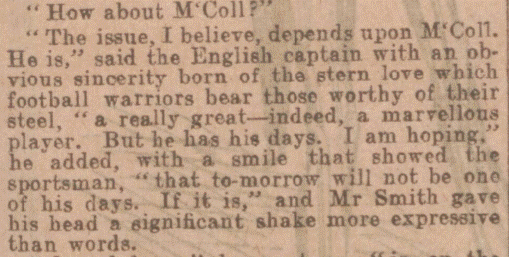
Prior to the match, a press representative asked G.O. Smith about R.S. McColl for the upcoming match. G.O.’s respect and admiration for McColl is evident in his response.
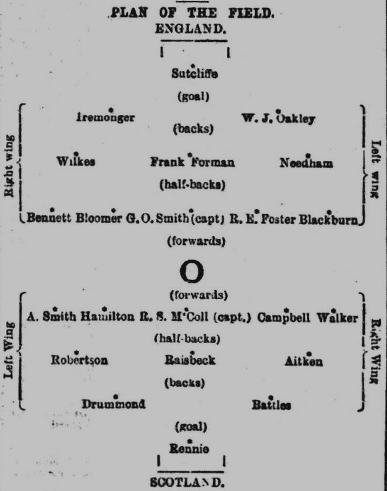
The stage was set, and the 1901 game was played on wet ground, which depending by whom it was reported, was either good for Scotland or for England. During the game, McColl distinguished himself multiple times including drawing a penalty in the box that was missed by the referee. However, Smith and the English side struggled to beat the solid Scottish defense. The game only ended a 2-2 tie due to a costly mistake by the Scottish back Jock Drummond near the end of the game, who gifted the ball to Steve Bloomer in front of the goal alone for an easy score.
While neither Smith nor McColl scored in the game, it was reported that McColl and the Scots were the superior team on that day despite the final score.
Yet in 1901, the subject of who was the best footballer continued to be subject of much discussion. While the English fans maintained the title still belonged to Smith, even the notoriously anti-Scottish English press had to concede that McColl was Smith’s equal.
For the past three years, he (McColl) has played for Scotland against England … and he has quite outshone even our English Champion G.O. Smith. The Athletic News, November 4, 1901
The Scottish press obviously felt McColl had done enough to demonstrate that he was indeed the superior player.
McColl was unquestionably the abler center … his (McColl) shooting and his passing were far ahead of G.O. Smith’s The Dundee Evening Post April 1901
Yet, it remained a hotly debated topic. So much so, that in 1902, the legendary sportsman C.B. Fry devoted an article looking back at the two great center forwards to shed some light on the matter. In the Dundee Evening Post – Tuesday 04 February 1902, he states “Whether on their best form, M’Coll or G.O. Smith … should be reckoned the better man is much-debated question. The truth is they are quite different in style.“

Fry, who had played with Smith at Oxford and the Corinthians chose to focus on their individual playing styles and strengths, sidestepping the question who was actually a better player. Yet, Fry conceded that “McColl was faster runner … more dangerous in the loose and he also is a more decisively rapid dribbler. However, Fry also acknowledged that in the 1901 English Scottish international “the Scottish half backs succeeded better in frustrating Smith than the English in rounding up M’Coll.” Fry claimed that this was due largely to the quality of the Scottish halfbacks of Andy Aiken, A.G. Raisbeck and Jack Robertson who were “unconscionably proficient“
Fry goes on to finish his piece praising both players and noncommittally stating: Happy the backs and the goalkeepers that see little of either of them.

The comparison between McColl and Smith continued to be discussed to the point that in an interview with the Evening Telegraph March 1, 1902 even, McColl himself was asked a leading question on G.O. Smith:
“How would you compare your style at center with that of G.O. Smith?”
McColl, the paragon of class and sportsmanship, could not be baited into the comparison and replied with a smile “Don’t you think that is rather personal?
However, John Cameron, the great play maker from Queens Park and Tottenham player/manager, who led Everton to a FA Cup in 1901, was less discreet in the comparison. His response is shown below in full.

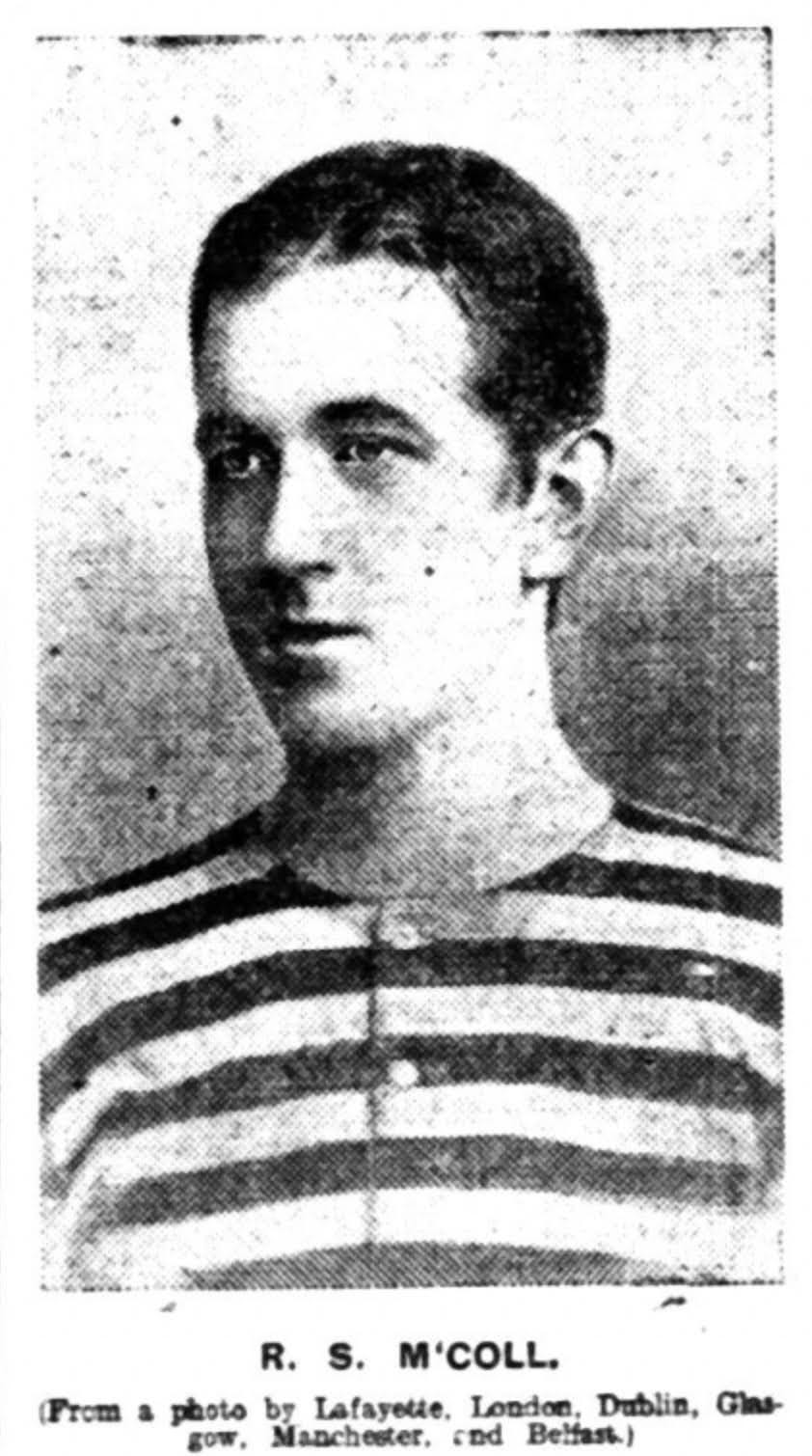
Following the international game in 1901, G.O. Smith decided to retire, whereas McColl’s career went an entirely different direction. Like his English counterpart, McColl had played as an amateur up to 1901, but decided to turn professional when he was almost signed by Liverpool but the team could not afford him. He ended up signing with Newcastle United for a considerable sum of 300 pounds. His time at Newcastle was challenging as the Scottish McColl was a marked man in the English league. It is said that he suffered many nasty and unfair fouls at the hands of English defenders, which took its toll on his legs and body and lowered his productivity.

After sustaining multiple serious injuries, he decided to return to Glasgow Rangers in 1904, after only three years with Newcastle. His time and injuries at Newcastle had taken their toll and his form for Glasgow Rangers was less sparkling than when he had been healthy. He played for the Rangers until 1907, when he requested to return to amateur status to play with Queens Park, which he did until 1912. Yet, to put the exclamation point on his almost mythical career, McColl scored an incredible 6 goals against Port Glasgow Athletic in the penultimate game of his career, a record that stands to this day.
To call to McColl as Scotland’s first superstar, might be considered unfair to earlier Scottish legends such as William Kerr, Charles Campbell, Harry McNeil, Archie Hunter and John Lambie. However, it is not a stretch to say that for five years between 1897 and 1902, McColl may have been the best footballer on the planet or at the very least certainly on equal footing to his contemporary English counterpart, the great G.O. Smith. That McColl received such admiration from English critics, which were notoriously hostile towards Scottish players, is a testament of his amazing talent.
It was always a moot point with the critics whether McColl or G.O. Smith was greatest center. In point of actual skill, I believe G.O. Smith was superior, but M’Coll had more dash, a quality that made a greater success in international matches. But they were both magnificent players, and at their best stood head and shoulders above the rest. The Tatler, September 24, 1902
His achievements on the field were recognized as McColl was inducted into the Scottish Football Hall of Fame in 2011.
These two great center forwards, like Messi and Ronaldo of today, were the two best football players in the world during their careers. Who was actually better? Let the debate rage on!
Cigarette Cards of R.S. McColl
R.S. McColl’s legend is also interesting from a cartophillic perspective. His first cigarette card comes from the exceptionally rare set from Rutherford’s Cigarettes circa 1899 /1900. In fact, McColl’s card sold in 2013 for an astonishing 6,200 pounds, which was largest amount ever paid for an association football card up till that point. Some have suggested that this card could be considered the association football equivalent of baseball’s T206 Honus Wagner card due to the quality of player and its extreme rarity. It is certainly a grail card for the most sophisticated collectors in the hobby.
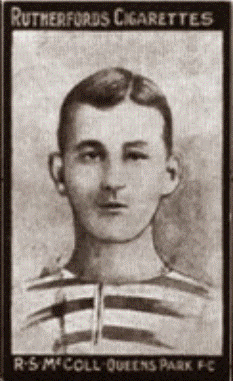
Additional Card Chronology

Ogden’s Cigarettes – General Interest N95 Series – circa 1900
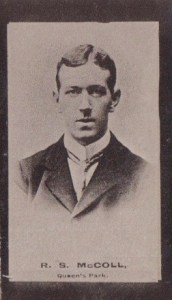
F & J Smith Cup Tie Cigarettes – Footballers – 1901/02
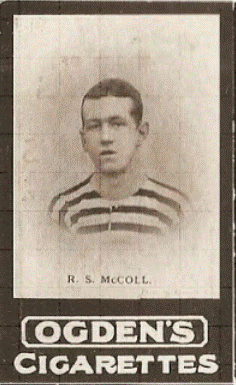
Ogden’s Cigarettes – Tabs Composite – Our Leading Footballers – 1901

Ogden’s Cigarettes – Tabs D Series – #180 – c1902
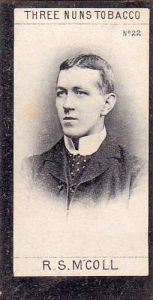
J & F Bell Three Nuns Tobacco – Footballers – 1902

Ogden’s Cigarettes – General Interest N97 – 1902
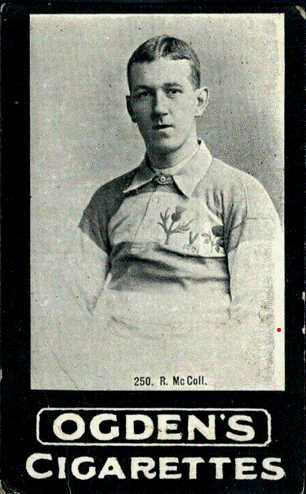
Ogden’s Cigarettes – Tabs – F Series – 1902

Gallaher Cigarettes – Association Football Club Colours – 1910
McColl also features on postcards, such as the Wrench and Harriot Series.

 The Cardboard Junkie
Excellent article with Great set of cards and information.
LikeLiked by 1 person
Thanks very much. Very glad you enjoyed it.
LikeLike